How Often Should You Release a Podcast Episode?
| TL;DR: There is no universal answer to how often you should release a podcast episode. The right schedule is the one you can actually maintain without burning out. Here is how to find yours. |
It is one of the first questions new podcasters ask.
How often should I release an episode? Weekly? Every two weeks? Daily?
And it is the wrong first question.
The better question is this: how often can you show up consistently, without dropping off, for the long game?
Because less than 8% of podcasters ever make it to episode 10. Not because they ran out of ideas. Not because their audio quality was not good enough. Because they did not build a schedule they could actually sustain.
The frequency you choose does not matter as much as the consistency behind it. A monthly podcast that publishes every single month will outperform a weekly podcast that goes silent for two months and comes back with an apology episode.
Here is how to figure out the right schedule for you and how to build the systems that make it real.
Why Podcast Release Frequency Matters More Than You Think
Consistency is the number one predictor of podcast survival. Not quality. Not production value. Not even topic.
When you show up on a schedule your audience can count on, two things happen.
First, your listeners build a habit around your show. They know when to expect you. They look for you. That habit is what turns a casual listener into a loyal one.
Second, podcast platforms and search engines reward consistent publishing. The more regularly you release, the more your show is surfaced to new potential listeners. According to BuzzSprout, the average podcast episode gets 28 downloads in the first 7 days. That number grows over time for shows that publish consistently because each episode adds to a searchable, discoverable archive.
Your podcast release schedule is not just a personal decision. It is a signal to algorithms, platforms, and audiences that your show is active and worth following.
Ready to build your podcast with a real strategy behind it? Explore the 6-Week Podcast Launch Strategy here
What the V.O.I.C.E. Method Says About Your Publishing Schedule
Most podcasters figure out their release schedule after they launch. They pick a frequency that sounds reasonable, try to keep up with it, and eventually burn out or go inconsistent.
The V.O.I.C.E. Method does it differently.
Your publishing schedule is built during the Outline phase, the O in V.O.I.C.E., before a single episode is recorded.
The Outline phase is where you establish the systems, tools, equipment, and workflow you will need to manage your podcast. The schedule lives here because it is a systems question, not a content question. How often you can realistically publish is determined by your production workflow, your available time, and the type of show you are creating.
By the time my clients start recording, they already know:
- What day their episodes will publish
- How far in advance they need to record to stay on schedule
- How long their editing process takes
- Whether they are batching episodes or producing week by week
- What their realistic capacity looks like across different seasons of life
The schedule is not an afterthought. It is part of the strategy.
And because it is built before the pressure of a launch week kicks in, clients are not making that decision from a place of anxiety or overconfidence. They are making it from an honest look at their actual life.
Weekly, Biweekly, or Monthly: Which Publishing Schedule Is Right for You?
Here is an honest breakdown of each frequency and who it works best for.
Weekly.
Weekly publishing is the strongest option for SEO discoverability and audience habit-building. You are in your listeners’ feeds consistently, the algorithm sees you as an active show, and your episode archive grows faster.
The tradeoff is that weekly publishing requires the most systems. If your production process takes you 5 hours per episode, you are committing 20 hours a month to your podcast before you account for promotion, email, or anything else.
My immigration podcast, The American Dream in the Eyes of Immigrants, publishes weekly every Tuesday. That schedule works because I have a streamlined production process, a VA who helps with the backend, and years of practice. I did not start there. I built up to it.
Biweekly.
Biweekly is the sweet spot for most entrepreneurs who are running a business alongside their podcast. You stay present in your audience’s feed without committing to a pace that requires a support system from day one.
My second show, Podcasting for Latina CEOs, runs on a biweekly schedule, releasing every other Thursday. Two shows, two different schedules, both working. The key is that both schedules were chosen intentionally, not inherited from what I thought I was supposed to do.
Monthly.
Monthly publishing works when episodes are long-form, deeply researched, or production-heavy. It also works for podcasters who are just starting and need time to build their production process before increasing frequency.
The risk with monthly publishing is visibility. Gaps between episodes give listeners more time to forget you exist. If you choose a monthly schedule, your marketing between episodes has to work harder.
The bottom line: pick the frequency you can actually sustain. Not the one that sounds most impressive.
What Are the Essential Steps to Release a Podcast Episode?
One of the reasons new podcasters get the frequency question wrong is that they underestimate how long it takes to produce an episode.
Publishing weekly sounds manageable until you realize everything that goes into each episode.
Here is what a complete podcast episode release process actually looks like:
Record.
This includes prep time, the actual recording, and any re-records. Solo episodes typically run faster. Interview episodes add scheduling, guest prep, and tech coordination.
Edit.
Removing mistakes, cleaning up audio, leveling volume, adding intro and outro. Plan for at least 1 to 2 hours of editing per 30 minutes of finished audio.
Write show notes.
Show notes are not optional. They are how your episodes get found through search. A strong set of show notes includes an episode summary, key takeaways, timestamps, and a call to action.
Create graphics and clips.
A cover image or episode graphic for social media. Short audiogram or video clips for promotion. These take time, but they drive discovery.
Schedule and publish.
Upload to your hosting platform, add your shownotes, and schedule the release date and time.
Promote.
Post to social media, send to your email list, share in relevant communities. An episode that does not get promoted is an episode that waits to be found by chance.
Add up the time for each of these steps honestly. That total is your true episode production time. Your publishing frequency should be set based on that number, not on what you think you should be doing.
Related: The Podcast Launch Checklist: 6 Things You Need Before You Record Episode 1
What Is the Best Day to Release a Podcast Episode?
Tuesday, Wednesday, and Thursday consistently outperform other days for podcast downloads.
The pattern makes sense. Listeners load up their queues at the start of the week and work through them during weekday commutes, workouts, and errands. Episodes released on Tuesday or Wednesday have the full weekday window ahead of them.
Monday releases tend to compete with the inbox and the start-of-week mental load. Weekend releases land when people are less likely to engage with new content.
That said, the best release day is the one you can commit to every single time without exception.
Consistency beats optimization. A podcast that always drops on Sunday morning builds a Sunday morning habit in its listeners. A podcast that aims for Tuesday but slips to Thursday or Friday loses that rhythm and that predictability.
My immigration podcast publishes every Tuesday. My second show publishes every other Thursday. Both days were chosen intentionally, and I do not move them. That reliability is part of what listeners trust.
Should You Edit Your Podcast Yourself or Hire Help?
Honest answer: it depends on where you are with your podcast.
When DIY makes sense.
If you are just starting out, editing your own episodes teaches you your show from the inside. You learn what sounds good, where you ramble, and how your content flows. That knowledge makes you a better podcaster. I edited my own episodes for years before I started offering the service to clients.
DIY also makes sense if your budget is tight and you have the time to invest in learning the process.
When outsourcing makes more sense.
If editing is the reason you are publishing late or not at all, outsourcing is not a luxury. It is a solution to an inconsistency problem.
If editing takes you 3 hours per episode, ask yourself what else you could be doing with that time. You could be serving clients, creating content, promoting your show, pitching guests, or working on the parts of your business that actually bring in revenue. When editing starts costing you time, energy, and consistency, it may be time to bring in help.
If your show is growing and production quality matters more to you now than it did when you started, a professional editor can help you create cleaner, more consistent episodes.
Explore Podcast Editing and Production Services here.
Podcast Editor vs. Producer: Which Do You Actually Need?
These two roles get confused constantly, and knowing the difference helps you figure out exactly where your bottleneck is.
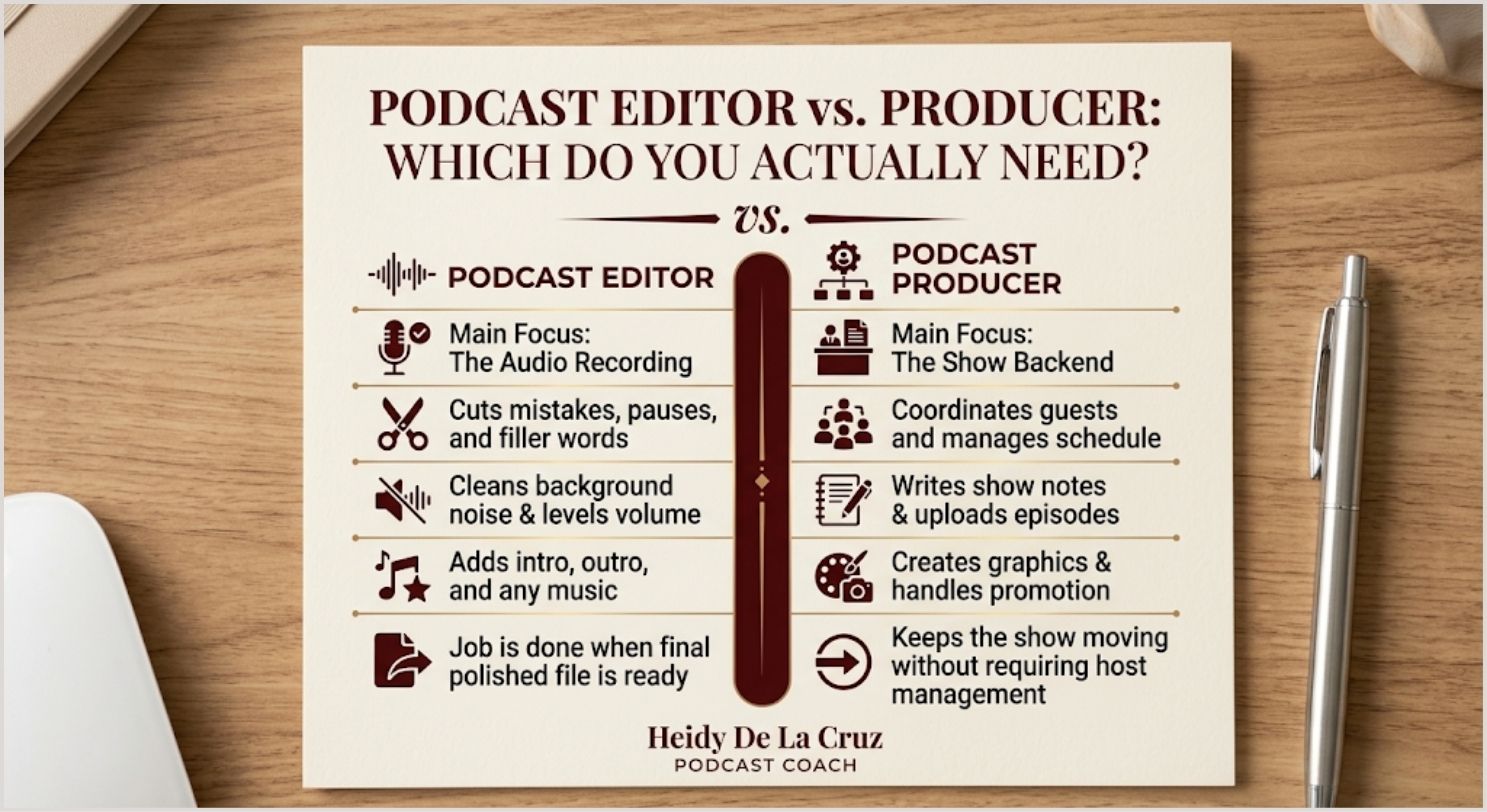
A podcast editor handles the audio.
They take your raw recording and turn it into a polished, publishable episode. That includes cutting mistakes, removing long pauses and filler words, cleaning up background noise, leveling volume, and adding your intro, outro, and any music. When the finished file is ready, their job is done.
A podcast producer handles the backend.
They manage the business of running your show: coordinating guests, managing the publishing schedule, writing show notes, uploading episodes, creating graphics, and handling the promotion pipeline. A producer keeps the show moving without requiring the host to manage every moving part.
Most podcasters who feel overwhelmed need one or the other, not both.
If your episodes take forever to get out because of the audio work, you need an editor.
If your episodes are edited but never make it to publish because the admin work piles up, you need a producer.
If both are true, a full-service production package might be the right fit. But start by identifying where the actual bottleneck is before paying for support you do not need yet.
Want support building your podcast launch strategy from the ground up? Explore the 6-Week Podcast Launch Strategy here
How to Build a Podcast Release Schedule You Can Actually Stick To
A schedule on paper is not the same as a schedule in practice. Here is how to build one that holds.
Start with your production time.
Time your full episode production process from record to publish. That number tells you how much time each episode actually requires. Set your frequency based on reality, not ambition.
Batch record when possible.
Recording two or three episodes in a single session is one of the most effective ways to stay ahead of your schedule. When life gets busy, you have a buffer. When you have a run of great energy, you capture it.
Plan your content in advance.
Knowing what you are recording before you sit down eliminates decision fatigue and speeds up the process. A simple content calendar, even a list of 8 to 10 episode topics planned out a month ahead, makes a significant difference.
Build in buffer.
Do not plan to record episode 5 the week before episode 5 is supposed to publish. Life happens. Build 2 to 3 episodes of buffer so a sick week or a busy season does not break your streak.
Treat your recording day like a meeting.
Put it on the calendar. Protect it. Record day is not optional. When it is scheduled and protected the same way a client call would be, it happens.
Related: My Process for Planning Solo Podcast Episodes
Want to talk through your podcast schedule and production workflow? Book a 1:1 Strategy Call here
FAQ: Podcast Release Schedule
Does releasing more episodes help you grow faster?
Not automatically. More episodes give search engines more content to index, which can help with discoverability over time. But publishing five episodes a week with no promotion strategy and no SEO will not grow your show faster than publishing one episode a week with a real plan behind it. Quality, strategy, and consistency matter more than volume.
Can I change my podcast release schedule after I launch?
Yes, and it is better to change it intentionally than to quietly go inconsistent. If you need to shift from weekly to biweekly, tell your audience. Give them a heads-up in an episode. Explain why. Listeners respect honesty more than silence, and a transparent schedule change is far less damaging than unexplained gaps.
How long should a podcast episode be?
As long as it needs to be and not a second longer. The research consistently shows that listener retention drops significantly after 30 minutes for shows that do not have an established audience. For newer shows, 15 to 25 minutes is a strong starting range. As your audience grows and their trust in you deepens, you can go longer. Let the content determine the length, but be honest about whether you are adding value or just filling time.
About the Author & Podcast Coach
Heidy De La Cruz is a podcast coach, host, and creator of the V.O.I.C.E. Method. Her podcast The American Dream in the Eyes of Immigrants is a 2-time award winner recognized by the Women in Podcasting Awards and Women Who Podcast. It ranks in the top 5% of podcasts globally, #1 on GoodPods for Immigration, and holds #1 keyword rankings on both Spotify and Apple Podcasts.
After launching her first podcast in 2022, she saw how many women had powerful stories, business ideas, and something worth saying but felt completely stuck by the tech, the moving parts, and the lack of a clear starting point.
Now she helps aspiring podcasters go from idea to live show with clear, hands-on support that makes launching feel doable instead of overwhelming.
Explore her services: 1:1 Podcast Launch Strategy, The V.O.I.C.E. Method Podcast Launch Course, and Podcast Editing and Production Services.
Key Takeaways
- The right podcast release frequency is the one you can sustain without burning out.
- Less than 8% of podcasters reach episode 10. Consistency is what gets you there.
- The V.O.I.C.E. Method builds your publishing schedule before you record a single episode.
- Tuesday, Wednesday, and Thursday outperform other days for downloads. But the best day is the one you keep.
- Know your true production time before you choose your frequency.
- Batch recording and content planning are the two habits that make consistency possible.
- If editing is why you are inconsistent, outsourcing is a strategy not a luxury.
With Love, Heidy
Related Resources
- The Podcast Launch Checklist: 6 Things You Need Before You Record Episode 1 — Everything you need to set up before you hit record.
- My Process for Planning Solo Podcast Episodes — How to plan content so your production schedule never falls behind.
- 3 Ways to Grow Your Podcast That Actually Work — Consistency is step one. Here is what comes next.
- Why Every Entrepreneur Should Consider Starting a Podcast — The business case for showing up consistently.