What Makes a Podcaster Different From a YouTuber? A Podcast Coach Explains
TL;DR: Podcasters and YouTubers are both creators, but they have completely different mindsets, workflows, and ways of building trust with their audiences. Knowing the difference can help you choose the right path for your goals before you invest time or money into either.
People ask me this question all the time.
“Should I start a podcast or a YouTube channel?”
And underneath that question is usually a deeper one:
“What’s actually different about the two?”
Because from the outside, they can look similar. Both involve a creator with a microphone. Both involve talking into a camera or a recorder. Both build audiences over time.
But as a podcast coach who has helped dozens of women launch their shows, I can tell you, a podcaster and a YouTuber are not the same kind of creator. The difference goes much deeper than the platform.
Let’s break it down.
What Differentiates a Podcaster From a YouTuber?
A podcaster’s primary tool is their voice. The way they speak, the energy they bring, the pauses they take, the stories they tell, that’s what keeps people coming back. Listeners tune in while driving, exercising, cooking. They’re not watching. They’re listening.
A YouTuber’s primary tool is their visual presence. Thumbnails, lighting, on-camera confidence, editing style, facial expressions, all of it matters before someone even hits play.
Neither is better. But they require very different strengths.
If you’re someone who communicates best through conversation and storytelling, and the idea of being on camera feels like a barrier, podcasting might be your lane. If you light up on video and think visually, YouTube might fit you better.
Ready to launch your podcast? Explore the 6-Week Podcast Launch Coaching Program ?
Podcasters Build Intimacy. YouTubers Build Visibility.
Here’s something I always say to aspiring podcasters:
When someone listens to your podcast, you are in their ears for 20, 30, 45 minutes. That’s intimate. That doesn’t happen on YouTube.
Podcasters build deep trust with a smaller, more engaged audience. Listeners feel like they know the host personally. They come back because of the relationship, not just the information.
YouTubers tend to build wider reach and visibility faster. The algorithm can push a video to thousands of people overnight. But that reach is often shallower; people subscribe and never come back.
A podcast listener who discovers your show will often go back and binge your older episodes. A YouTube subscriber might watch one video and move on.
It comes down to what matters more to you right now: depth of connection or breadth of reach.
Did you know that people trust podcasters more than YouTubers? Yes! According to Acast research!
The Workflow Is Completely Different
A lot of people think podcasting and YouTube are similar in terms of production. They’re not.
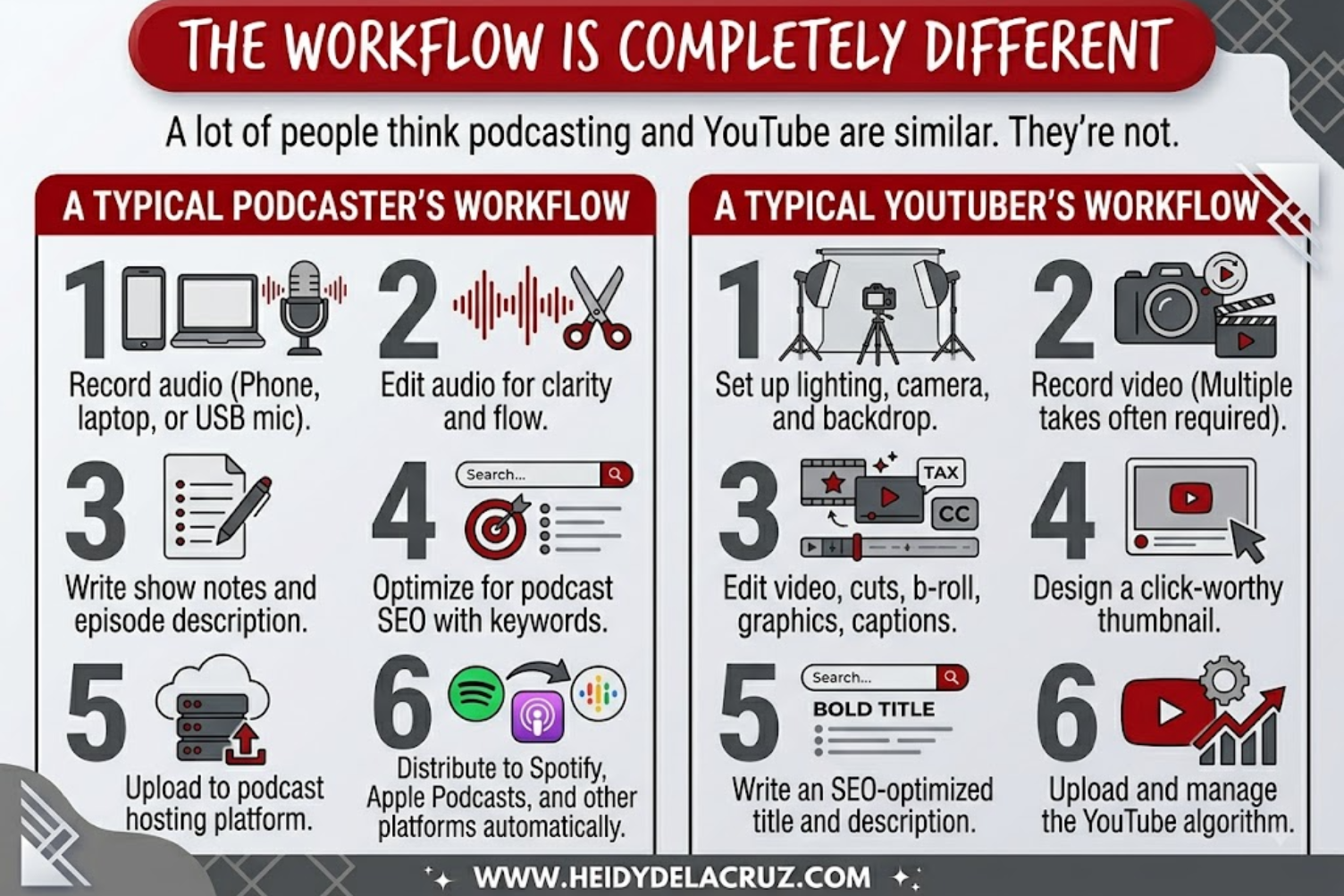
A typical podcaster’s workflow:
- Record audio (phone, laptop, or USB mic)
- Edit audio for clarity and flow
- Write show notes and episode description
- Optimize for podcast SEO with keywords
- Upload to podcast hosting platform
- Distribute to Spotify, Apple Podcasts, and other listening platforms automatically
A typical YouTuber’s workflow:
- Set up lighting, camera, and backdrop
- Record video (multiple takes often required)
- Edit video, cuts, b-roll, graphics, captions
- Design a click-worthy thumbnail
- Write an SEO-optimized title and description
- Upload and manage the YouTube algorithm
Podcasting has a lower production barrier. You can record a solid episode with your phone and a quiet room. YouTube demands more, visually and technically, before it even gets watched.
If you’re thinking about starting a podcast, read: The 6 Things You Need Before You Record Episode 1, a checklist to get you ready without the overwhelm.
Podcasters Play the Long Game. YouTubers Can Go Viral Overnight.
This one is important to be honest about.
YouTube has a much higher potential for rapid growth. One video can go viral and bring in tens of thousands of subscribers. The algorithm actively serves content to new viewers.
Podcasting grows differently. It’s slower, more steady, and more cumulative. Each episode adds to a library that keeps working for you through search. A podcast episode published two years ago can still bring in new listeners today.
According to BuzzSprout, the average podcast episode gets 27–30 downloads in the first 7 days. That’s not a viral moment. But those listeners? They’re often your most qualified audience.
Podcasting rewards patience and consistency. If you’re building a business or a brand and want content that compounds over time, podcasting is one of the smartest long-term strategies out there.
Want to understand the deeper business case? Why Every Entrepreneur Should Consider Starting a Podcast breaks it all down.
What About Equipment? Is One More Expensive Than the Other?
Generally, yes, YouTube is more expensive to start.
To make a YouTube channel that looks professional, you typically need a camera, lighting, a backdrop or clean space, and video editing software. That adds up quickly.
Podcasting is more accessible. You can start recording on your phone. As you grow, you might upgrade to a USB mic or an interface, but the entry point is much lower.
Not sure what gear you actually need? The Best Podcast Setup: Cheap vs. Premium, Which Is Worth It? covers your options at every budget.
Can You Be Both a Podcaster and a YouTuber?
Yes, and many creators are.
Some podcasters record their episodes on video and upload to YouTube as well. This is called a video podcast, and it’s growing. It lets you capture the intimacy of podcasting and the discoverability of YouTube at the same time.
But here’s my honest advice: don’t try to do both from day one. Pick one, build your systems, get consistent, then expand.
Trying to master both platforms simultaneously is one of the fastest ways to burn out before you ever find your audience.
I go deeper on this comparison in: Podcasting vs. YouTube Channel: Why They’re Not the Same, including which platform is right for different goals and business types.
Not sure which format fits your story and goals? Take the quiz to find out ?
FAQ: Podcaster vs YouTuber
Is a podcast better than YouTube for building an audience?
It depends on what kind of audience you want to build. Podcasting builds a smaller, more loyal audience with deeper trust. YouTube can build faster, wider reach but often with less engagement. If you’re selling a service or building a coaching business, a podcast audience converts better. If you want mass visibility and brand awareness, YouTube has the edge.
Do podcasters need to be on YouTube too?
No. You can have a successful podcast with zero YouTube presence. Many top podcasts live only on audio platforms and do incredibly well. YouTube can be an additional distribution channel if it makes sense for your strategy, but it’s not a requirement.
Is podcasting easier than YouTube?
In terms of production, yes. You don’t need a camera, lighting, or video editing skills to start a podcast. Audio editing is simpler, the equipment is cheaper, and the barrier to entry is lower. But the consistency required to grow a podcast is just as real as YouTube, the format is just more accessible.
What do podcasters and YouTubers have in common?
More than you’d think. Both require consistency, a clear niche, a reason to keep going past the early stages when growth feels slow, and the ability to connect with an audience over time. The platforms are different but the creator mindset is the same: show up, provide value, and keep going.
About the Author & Podcast Coach
Heidy De La Cruz is a podcast coach, host, and creator of the V.O.I.C.E. Method. Her podcast The American Dream in the Eyes of Immigrants is a 2-time award winner recognized by the Women in Podcasting Awards and Women Who Podcast.
After launching her first podcast in 2022, she saw how many women had powerful stories, business ideas, and something worth saying but felt completely stuck by the tech, the moving parts, and the lack of a clear starting point.
Now she helps aspiring podcasters go from idea to live show with clear, hands-on support that makes launching feel doable instead of overwhelming.
Explore her services: 1:1 Podcast Launch Strategy, The V.O.I.C.E. Method Podcast Launch Course, and Podcast Editing and Production Services.
Your voice deserves to be heard, and Heidy is here to help you bring it to life.
Key Takeaways
- Podcasters lead with voice and intimacy. YouTubers lead with visuals and reach.
- Podcast audiences are smaller but more loyal, they convert better for service-based businesses.
- Podcasting has a lower production barrier and lower startup cost than YouTube.
- YouTube can grow faster. Podcasting compounds longer.
- You can do both, but start with one, build consistency, then expand.
Ready to Become a Podcaster?
If this breakdown is helping you lean toward podcasting, that’s exactly where I can help.
The 6-Week Podcast Launch Coaching Program is designed to take you from idea to fully launched show, with a clear strategy, the right systems, and support every step of the way.
Here’s where to start:
- Podcast Launch Workbook: Your starting point before you hit record.
- V.O.I.C.E. Method Podcast Launch Course: The full self-paced roadmap from idea to launch.
- 1-Hour Podcast Strategy Call: Bring your questions. Leave with a clear plan.
- 6-Week 1:1 Podcast Launch Coaching: Full support, weekly sessions, and a podcast launch you’re proud of.
With Love, Heidy