
The Podcast Description Test: Can People Tell What Your Show Is About?
| TL;DR: If someone reads your podcast description and can’t tell what your show is about in 10 seconds, you’re losing listeners before they ever hit play. A clear, keyword-optimized podcast description is one of the easiest SEO wins you can make, and most podcasters skip it entirely. |
Your podcast description is doing one of two things right now. It’s either pulling in the right listeners or quietly turning them away. And most podcasters have no idea which one it is.
I recently served as a judge for the PodGround Creator Micro-Grant, where I reviewed 5+ podcast applications from creators around the world. One pattern showed up over and over: the podcast description said one thing, but the episodes delivered something completely different. Listeners and judges were confused. And confused people don’t hit subscribe.
That experience made me want to write this post. Because a misaligned podcast description isn’t just a branding problem. It’s a podcast SEO problem. And it’s costing you more than you think.
Let’s run the test.
What Is a Podcast Description, And Why Does It Matter for SEO?
Your podcast description is the paragraph (or two) that appears on Apple Podcasts, Spotify, and every other platform where your show lives. It tells new listeners what your show is about, who it’s for, and what they can expect.
But here’s what most podcasters don’t realize: your podcast description is also a key part of your podcast SEO strategy. Podcast platforms use the text in your description to understand what your show is about and match it to listener searches. That means your podcast keywords need to live in your description, not just in your episode titles.
When your podcast description is vague, generic, or misaligned with your actual content, two things happen. Potential listeners don’t connect with it and scroll past. And the algorithm doesn’t know who to show it to.
If you want to understand how search engines and podcast platforms index your content, my post on what podcast SEO is and where to optimize it is a good place to start.
The Podcast Description Test (Do This Right Now)
This takes less than two minutes. Open your podcast on Apple Podcasts or Spotify and read your description out loud as if you’re a brand new listener who knows nothing about your show.
Then answer these three questions:
1. Can you tell what the show is about in one sentence? Not a vague idea, an actual topic. “Personal growth” is not specific enough. “Career transitions for women over 40” is.
2. Can you tell who it’s for? Does your podcast description name your listener? If someone from your exact target audience reads it, do they immediately see themselves in it?
3. Does it match your actual episodes? Pull up your last three episode titles. Do they line up with what your description promises? If someone subscribed based on your description, would they feel like they got what they signed up for?
If you answered no to any of these, your podcast description needs work. And the good news is it’s one of the easiest fixes in all of podcast SEO.
What I Saw Judging the PodGround Grant (The Real Problem)
When I was reviewing applications for the PodGround Creator Micro-Grant, I could see the podcast description, the application answers, and the submitted episodes side by side. And the disconnect was real.
One applicant described their show as a business podcast for entrepreneurs. But the episodes were personal storytelling with no business angle. Another described their show as mental health content, but the episodes were more lifestyle and motivational. Neither was wrong, but neither matched.
Here’s why that matters beyond just the grant: if a judge couldn’t figure out what the show was, neither could a first-time listener. And neither could the algorithm.
Your podcast description is your first impression. It’s the difference between a listener pressing play or scrolling to the next show. And it’s one of the first places your podcast keywords need to appear for your show to be discoverable at all.
How to Write a Podcast Description That Works
A strong podcast description does three things at once: it speaks to your target listener, includes your main podcast keywords, and accurately represents what your show delivers.
Here’s a simple framework:
Line 1, What the show is about (include your main keyword) Be direct. Name the topic. This is where your primary podcast keyword lives.
Example: “The Latina CEO Podcast is a weekly show about podcasting, digital marketing, and building an online business as a Latina entrepreneur.”
Line 2, Who it’s for: Get specific. Name the person who should be listening.
Example: “This show is for Latinas who want to grow their podcast, build visibility, and monetize their voice, without burning out.”
Line 3: What they’ll get. Tell them the outcome. What changes for them after listening?
Example: “Every episode covers real strategies, honest conversations, and actionable steps you can take this week.”
Line 4, Your secondary podcast keywords + call to action. Weave in supporting terms naturally and invite them in.
Example: “Subscribe and join a community of Latina podcasters growing their shows through podcast SEO, content strategy, and community.”
This is the structure I walk through in my podcast SEO audit, because your description is one of the first things I check.
The Podcast Description and Your Episode Titles Have to Match
Here’s something that trips up a lot of podcasters. You spend time getting your podcast description right, but then your episode titles don’t reflect it.
Your podcast description sets the promise. Your episode titles keep it. When those two things are aligned, your show builds trust with listeners and with the algorithm.
For a deep dive on optimizing your episode titles for search, check out my post on how to create SEO-optimized podcast episode titles. It walks through exactly how to use tools like ChatGPT and Capitalize My Title to get your titles working for you.
And if you want to go deeper on podcast title SEO and keywords, my post on the basics of SEO breaks down where keywords should live across all your podcast content, not just the description.
Show Notes Are an Extension of Your Podcast Description
Once your podcast description is solid, your show notes need to support it. Think of your show notes as the per-episode version of your description; they tell listeners what this specific episode covers and give you another opportunity to use your podcast keywords in context.
If your show notes are an afterthought (or a one-liner), you’re leaving podcast SEO value on the table. My post on how to write your show notes covers exactly what to include and how to format them for both listeners and search.
And if you want to take it further, repurposing each episode into a full blog post is one of the best ways to compound your podcast SEO over time. I break down my exact process in how to repurpose podcast episodes into blog posts.
What if writing show notes only took you 20 minutes? That’s what the Podcast Show Notes Template is for. Get the Show Notes Outline
What Happens When You Fix Your Podcast Description
When your podcast description is clear, keyword-optimized, and aligned with your episodes, a few things shift:
New listeners immediately understand whether the show is for them, which means the ones who subscribe are the right ones. Your podcast platforms know what search terms to surface your show for. And your overall podcast SEO starts working the way it’s supposed to.
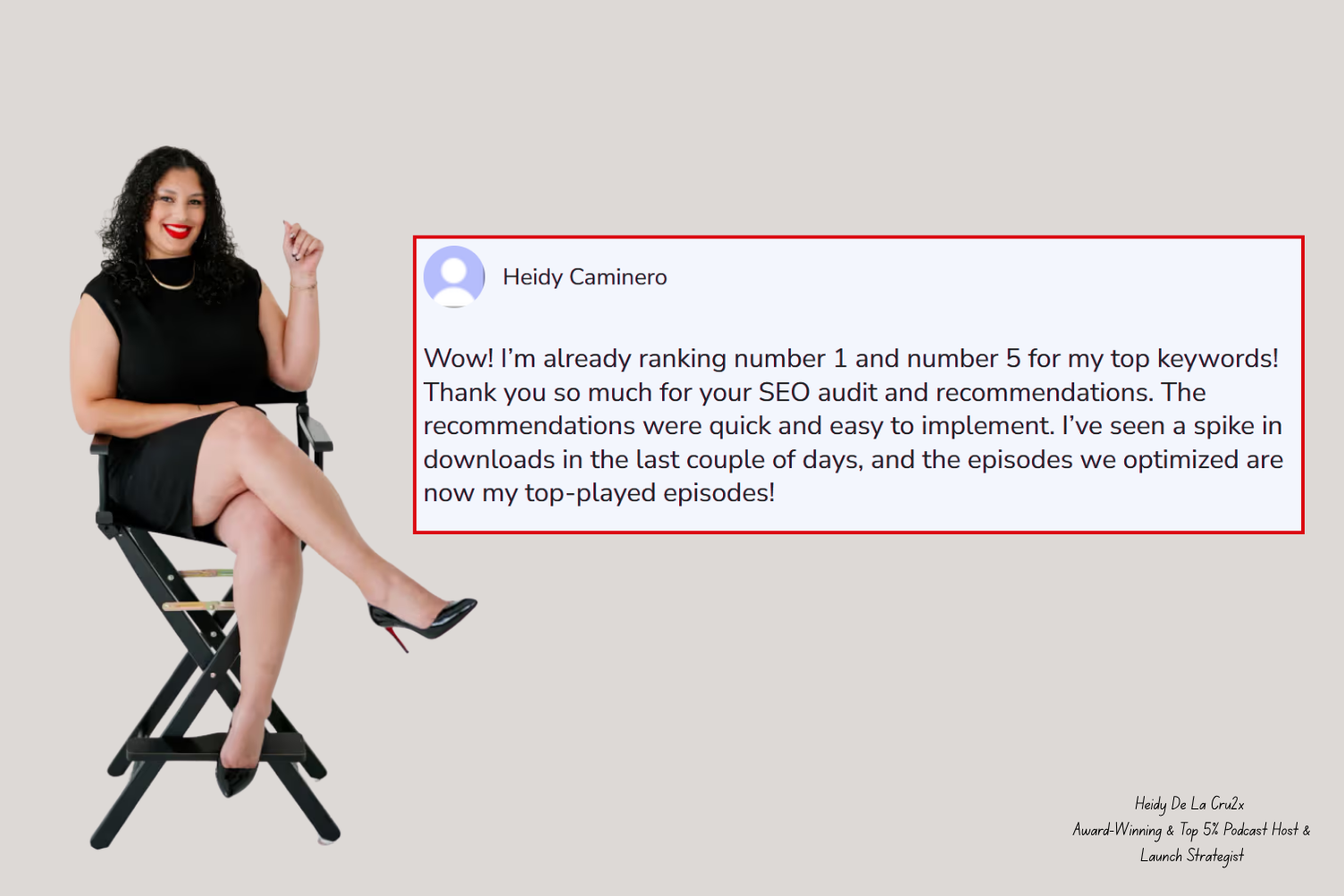
Here’s what one of my clients experienced after we optimized her podcast SEO, including her podcast description, episode titles, and keywords:
“Wow! I’m already ranking number 1 and number 5 for my top keywords! Thank you so much for your SEO audit and recommendations. The recommendations were quick and easy to implement. I’ve seen a spike in downloads in the last couple of days, and the episodes we optimized are now my top-played episodes!”, Heidy Caminero
That kind of result doesn’t come from overhauling everything. It comes from fixing the right things, and your podcast description is one of them.
FAQ’s About Podcast Descriptions
How long should a podcast description be?
Most podcast platforms display between 200–300 characters before cutting off with a “read more.” Your most important information, including your main podcast keyword, should appear in those first two lines. The full description can be longer (up to 4,000 characters on most platforms), but don’t bury the lead.
Can I change my podcast description after I’ve already launched?
Yes, and you should if it’s not working. Your podcast description is not permanent. Log into your hosting platform and update it anytime. Just make sure your new description still aligns with the episodes you’ve already published, and give the platforms a few days to reflect the changes.
Where else should my podcast keywords appear besides the description?
Your podcast keywords should live in your show title, episode titles, show notes, and any blog posts you write for your episodes. The more consistently they appear across your content, the stronger your podcast SEO signal becomes. This is exactly what I audit in a podcast SEO audit.
About the Author & Podcast Coach
Heidy De La Cruz is a podcast coach, host, and creator of the V.O.I.C.E. Method. Her podcast The American Dream in the Eyes of Immigrants is a 2-time award winner recognized by the Women in Podcasting Awards and Women Who Podcast. It ranks in the top 5% of podcasts globally, #1 on GoodPods for Immigration, and holds #1 keyword rankings on both Spotify and Apple Podcasts.
After launching her first podcast in 2022, she saw how many women had powerful stories, business ideas, and something worth saying but felt completely stuck by the tech, the moving parts, and the lack of a clear starting point.
Now she helps aspiring podcasters go from idea to live show with clear, hands-on support that makes launching feel doable instead of overwhelming.
Explore her services: 1:1 Podcast Launch Strategy, The V.O.I.C.E. Method Podcast Launch Course, and Podcast Editing and Production Services.
Want to Know How Your Podcast Description Is Actually Performing?
That’s exactly what my Podcast SEO Audit is for.
I review where your show ranks for your target keywords, check your podcast description, episode titles, and show notes for SEO gaps, and send you a clear set of recommendations you can implement right away, just like Heidy Caminero did.
Book your Podcast SEO Audit here ?
Your show deserves to be found. Let’s make sure it is.
Key Takeaways
- Your podcast description is both a listener conversion tool and a podcast SEO asset; it needs to do both jobs well.
- If your description doesn’t match your episodes, you’re confusing listeners and the algorithm at the same time.
- Include your main podcast keyword in the first two lines of your description where it’s visible before the “read more” cutoff.
- Your podcast description, episode titles, and show notes should all reinforce the same keywords and promise.
- Fixing your podcast description is one of the fastest wins in podcast SEO, and one of the most overlooked.