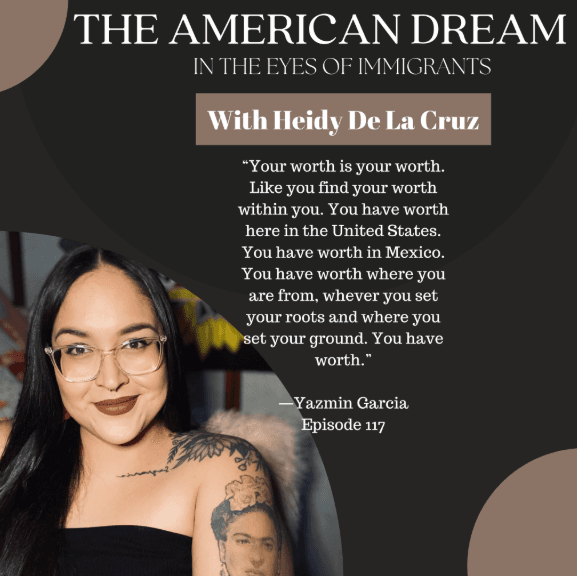
Yasmin Garcia: The Latina Immigrant Who Healed Through Art and Advocacy
| TL;DR: Yasmin Garcia immigrated from Mexico as a toddler, left the US at 17 to protect her family’s residency case, came back determined to prove herself, burned out, survived postpartum depression, and found healing through art. Her business, Sagrario Arte Studio, is now her legacy and her message to other women: you are enough. |
Immigration stories shape the fabric of the United States. They speak of hope, hardship, and the ongoing pursuit of a better life.
But some stories go deeper than the crossing. They follow the person through everything that comes after: the pressure to prove themselves, the quiet unraveling, and the long road back to who they were always meant to be.
This is one of those stories. On this episode of The American Dream in The Eyes of Immigrants, I sat down with Yasmin Garcia, a Latina immigrant, mother, and artist whose journey is one of the most layered and honest conversations I have had on this podcast.
From Guadalajara to Los Angeles: A Family’s Crossing
Yasmin Garcia’s journey began in Guadalajara, Jalisco, Mexico. She lived there for her first two years. She doesn’t remember much from that time. However, she knows her family lived in a multi-generational home. Her grandparents lived on the ground floor, and her family occupied the upper level. This arrangement is common in Mexico, where families often build additional floors for new generations.
The decision to move to the United States came from her uncles.
They encouraged her father to come over. In 1994, Yasmin Garcia’s father became the first to immigrate. He faced a turbulent year in Los Angeles. He experienced both the LA riots and a major earthquake. These events almost made him return to Mexico.
Her mother, however, was resolute. She gave him an ultimatum: either he returned, or the family would join him. He chose for them to come. Yasmin Garcia recalls her mother telling different versions of their crossing, suggesting the journey was complex and likely dangerous. They settled in Los Angeles, initially living in a small apartment with three to four other families. This chaotic, yet loving, environment reminded Yasmin Garcia of the children’s show “Casa Grande.” For her, it was normal. It was her childhood.
Have a story like Yasmin’s that deserves to be heard? The V.O.I.C.E. Method Podcast Launch Course gives you the roadmap to share it ?
Las Vegas, Her Brother’s Health, and a Residency Case That Changed Everything
In 1997, the family moved to Las Vegas. Her uncles had already found opportunities there. Las Vegas quickly became home, a diverse place she both loved and hated at times.
Her brother faced a speech delay as a child. This health issue became central to the family’s immigration status. At nearly five years old, he struggled to communicate. His parents sought therapy and support for him. Through this, they learned they could petition for residency. The argument was that deporting them would remove vital resources for their American citizen son.
They won their case.
But their lawyers advised against including Yasmin in the initial petition. They worried it would jeopardize the entire application. They said her parents could petition for her later.
That one legal decision set the stage for one of the hardest choices of her life.
Related: From Deportation to Empowering Latinas with Gicela Holguin — another story of navigating the immigration system and refusing to let it define the ending.
The Impossible Choice She Had to Make at 17
When her parents received their residency, Yasmin was 15. By the time her application was processed, she was 17. Her lawyer gave her two options:
- Leave the country before turning 18.5, return to Mexico as a minor, and wait anywhere from one to five years for an appointment in Ciudad Juarez.
- Stay in the US, finish high school with honors, and risk being classified as an adult by immigration, making it impossible for her father to petition for her.
She was 17.
She chose to leave.
In January 2011, she dropped out of high school, just months before graduation. Her art teacher, who had always believed in her, gave her a personal phone number and promised she would graduate with honors when she returned. That act of faith carried her through what came next.
A Year in Mexico: Lost Between Two Cultures, Found in Community
In March 2011, at 17, Yasmin returned to Mexico for the first time since she was two.
She didn’t fit. Children mocked her Spanish accent. She fell into a deep depression, caught between two identities and belonging to neither. “I don’t fit over there, but I don’t fit in here,” she recalled.
Her mother encouraged her to move in with an aunt in a more populated area. That decision changed everything.
Her aunt brought her into the community. She joined her selling items from catalogs, explored local restaurants, and bonded with cousins who showed her Mexico as a young adult. She rode buses alone, got lost, and found that people were always willing to help. “Don’t worry, I got you,” they would say.
She started running in a forest at 5 AM. She found courage she didn’t know she had. By the end of that year, she had found community, love, and a sense of belonging she hadn’t expected.
Also on the podcast: Miss Paulette on Why Immigrant Stories Need to Be Told in Their Own Words — on why the full story, including the hard parts, is what makes a narrative powerful.
Coming Back With a Vengeance and Then Burning Out
In February 2012, her immigration appointment arrived. The process was nerve-wracking but the officer was kind. He put her at ease, asked a few questions, and confirmed her case was processed.
She walked out of that building in tears. Her father and aunt were waiting. They cried together and went ice skating in the cold Ciudad Juarez weather to celebrate.
Returning to the US, she was determined to prove herself. She contacted her art teacher, completed her high school diploma with honors, applied to college, and got her first job.
“I came back with a vengeance,” she said.
For three years, she pushed herself relentlessly. But that drive led to burnout and imposter syndrome. She began questioning whether she even deserved what she had achieved.
“I’m so proud of my younger self,” she reflects now. “But if I could go back, I would tell her: you don’t have to prove yourself. You’re enough. Slow down. Go get therapy. Go heal.”
Motherhood, Postpartum Depression, and the Turning Point
She married in 2014. Her husband, also from Guadalajara, supported her as they began his residency process. Yasmin became a US citizen at 25, bringing her baby girl to the ceremony. She has a cherished photo with the judge, her daughter holding a small flag. She found a stable corporate job that covered her children’s healthcare. But she hated the work.
In 2020, during the pandemic, she worked from home with two young children under five. By 2022, after her third child, she could not continue. She was exhausted because she had been running since she was 17.
She faced severe postpartum depression. It became a turning point.
“It’s time to heal, baby,” she told herself.
Have a story like Yasmin’s that deserves to be heard? The V.O.I.C.E. Method Podcast Launch Course gives you the roadmap to share it
How Art Became Her Path to Healing
Art had always been there. In elementary school, a teacher recognized her talent. “You have a gift,” she said. “Promise me you will keep nurturing it.”
But her parents, focused on survival, dismissed it. “That’s not gonna pay your bills.” Society’s image of the starving artist stuck. She pursued a corporate career she hated instead.
It was the pandemic, motherhood, and postpartum depression that brought her back to it.
The COVID-19 pandemic and her experience with motherhood, particularly postpartum depression, reignited her artistic passion. She asked herself, “What do I want my children to remember me as?” She didn’t want to be remembered as the sad or just surviving mom. She wanted to be remembered as an artist, someone who pursued her passions. This desire to set an example for her children gave her purpose. She wanted them to know that with hard work, anything is possible.
She now works from a small studio in her kitchen. This corner, she explains, allows her to balance motherhood with her creative pursuits. She schedules her days, treating her art as a job. This structured approach helps her manage her time and commitment.
Her small business, Sagrario Arte Studio, honors her mother, whose name is Sagrario. Sagrario means “sacred,” a fitting name for something so personal and meaningful. She focuses her art on women’s empowerment and mental health within the Latin community. Her message is clear: “You’re not alone. You have worth.”
Her artwork has gained recognition. One piece was featured at the Mayor’s Museum from November to February. It then moved to El Consulado de Mexico in Las Vegas. These achievements validate her decision to pursue art.
Sagrario Arte Studio: Her Mother’s Name, Her Life’s Work
Her business is called Sagrario Arte Studio.
Sagrario is her mother’s name. It means “sacred.” She chose it because this work is sacred to her. It honors where she came from and the woman who gave her an ultimatum in 1994 that ultimately brought her to this country.
Her art focuses on women’s empowerment and mental health within the Latin community. Her message is clear and consistent: “You’re not alone. You have worth.”
One piece was featured at the Mayor’s Museum from November to February. It then moved to El Consulado de Mexico in Las Vegas. These achievements are not just professional wins.
They are validation that the choice to heal, to create, to show up for herself, was the right one.
What the American Dream Means to Yasmin Now
For Yasmin Garcia, the American Dream has evolved.
It is no longer just about financial success or traditional metrics. Her dream now centers on finding peace and personal fulfillment. “We’re more than our work,” she says.
She wants to chase her passions, build community, and use her voice. She acknowledges what she misses about Mexico: the strong community ties, the way neighbors genuinely connect and support each other.
But Las Vegas, with its diverse population, has become her home. Her husband is rooted there. Her children are growing up there.
The American Dream she carries now includes healing, self-expression, and contributing to something bigger than herself. It includes art. Also, includes her mother’s name on a studio door. It includes a message to every Latina woman who is running on empty:
“Do something for you, mama.”
Why She Decided to Share Her Story Publicly
Yasmin chose to speak publicly about her immigration journey after facing hate online.
Even after doing everything the right way to gain legal status, she still faced criticism. That motivated her to speak out. Not for herself alone, but for the young people who are scared and need to see that it is possible to survive the process and build something beautiful on the other side.
“Don’t let those dictate you. Don’t let those consume you,” she says. “Your worth is your worth.”
Her art is the story she tells without words. And this podcast is where she got to tell it with them.
FAQ: Immigration, Burnout, and Healing
What is immigrant burnout and how does it show up?
Immigrant burnout often comes from the compounded pressure to prove yourself in a country that required so much sacrifice to reach. It can look like overachievement, inability to rest, imposter syndrome, and eventually physical and emotional exhaustion. Yasmin describes it clearly: she came back with a vengeance and pushed herself for years before her body and mind finally said enough.
How can art help with postpartum depression and burnout?
Creative expression gives people a way to process emotions that words alone cannot hold. For Yasmin, art became the outlet that therapy and survival mode had never fully provided. Research by Brene Brown and others supports the connection between creativity and emotional well-being. Art is not a cure but it can be a powerful container for healing, especially for women who have spent years taking care of everyone else.
About the Author & Podcast Coach
Heidy De La Cruz is a podcast coach, host, and creator of the V.O.I.C.E. Method. Her podcast The American Dream in the Eyes of Immigrants is a 2-time award winner recognized by the Women in Podcasting Awards and Women Who Podcast. It ranks in the top 5% of podcasts globally, #1 on GoodPods for Immigration, and holds #1 keyword rankings on both Spotify and Apple Podcasts.
After launching her first podcast in 2022, she saw how many women had powerful stories, business ideas, and something worth saying but felt completely stuck by the tech, the moving parts, and the lack of a clear starting point.
Now she helps aspiring podcasters go from idea to live show with clear, hands-on support that makes launching feel doable instead of overwhelming.
Explore her services: 1:1 Podcast Launch Strategy, The V.O.I.C.E. Method Podcast Launch Course, and Podcast Editing and Production Services.
Key Takeaways from Yasmin’s Story
- Doing everything the right way as an immigrant does not protect you from difficulty. But it can lead to something powerful on the other side.
- Burnout is not a personal failure. It is what happens when you run for years without stopping to heal.
- Art, creativity, and community are not luxuries. They are essential to mental health and personal identity.
- The American Dream is not one-size-fits-all. Yasmin’s version includes peace, purpose, and her mother’s name on a studio door.
- Your story, shared publicly, can become someone else’s survival guide.
This blog post is sponsored by 360 Immigration Law