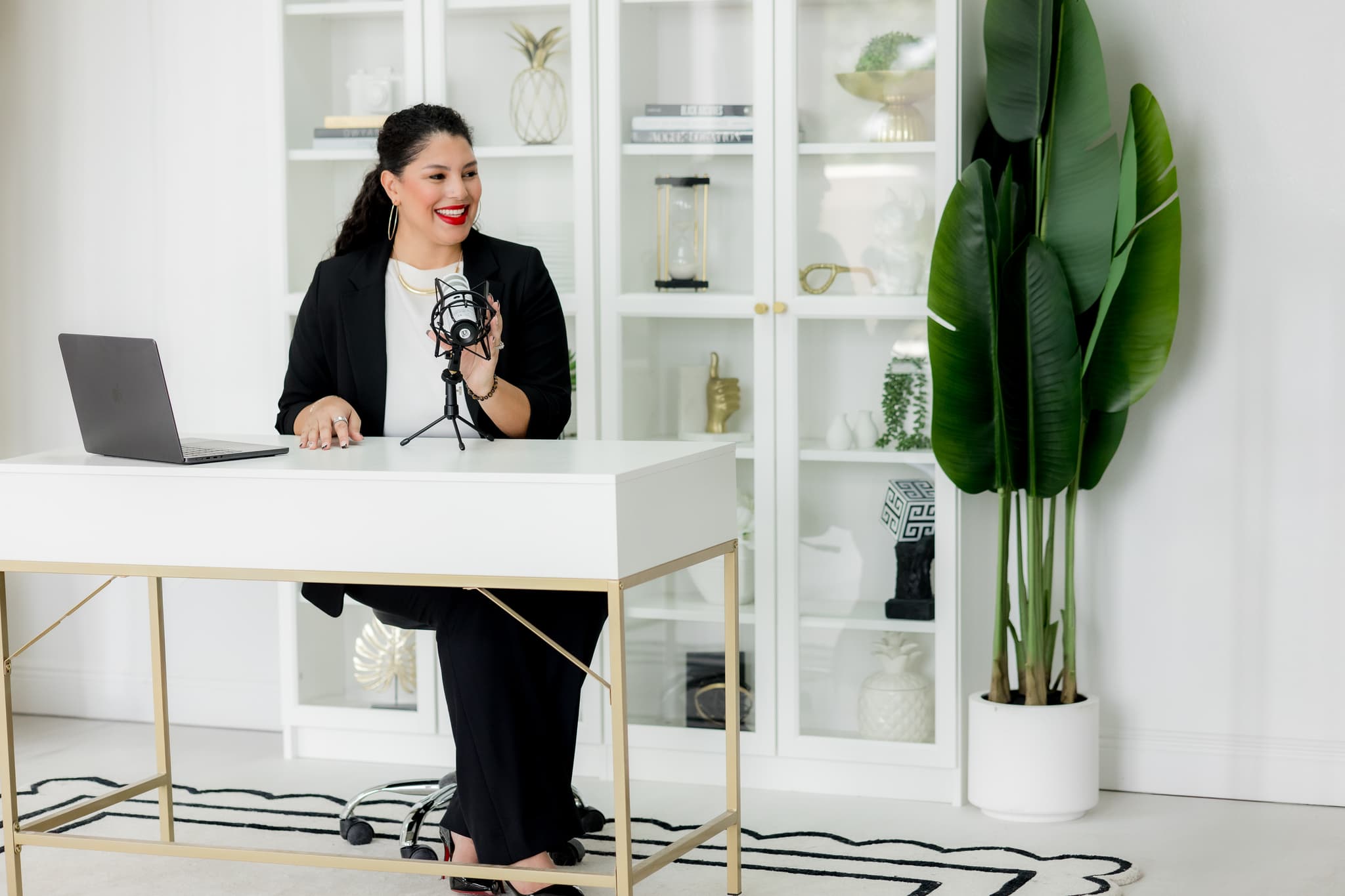
How to Start a Podcast: A Real Guide for Latinas Ready to Be Heard
Most “how to start a podcast” guides are written for everyone. They assume you have unlimited time to research microphones, that you’re not already second-guessing whether your accent is too strong or your story too niche, and that your biggest problem is choosing between two hosting platforms. For Latinas who have been quietly told that mainstream media wasn’t built for them, those guides miss the point entirely.
Your story already has an audience. The gap in podcasting for Latina voices is real, and it is wide. Hispanic hosts remain severely underrepresented in a medium that has grown to include hundreds of thousands of active shows. That gap is an opening, not a barrier. The barrier is the overwhelm that comes from guides written for a hypothetical average podcaster who looks nothing like you.
This guide cuts through the noise. We’ll cover the five decisions that actually matter before you record anything, the gear setup that gets you to launch without draining your savings, and the systems that keep you going past the first three episodes. By the end, you’ll have a clear path forward, not a longer list of things to research.
Why Most Podcast Guides Set You Up to Overthink (And What to Do Instead)
The typical beginner’s guide to podcasting opens with a gear list. Microphones, audio interfaces, pop filters, acoustic panels. Before you’ve recorded a single word, you’re comparing condenser versus dynamic microphones and wondering if your closet has enough clothes hanging in it to dampen the sound. This approach puts the cart so far ahead of the horse that most aspiring podcasters never leave the research phase at all.
Overthinking is the number one reason new podcasts never launch. The second reason is closely related: perfectionism dressed up as preparation. Many aspiring podcasters spend weeks building a brand identity, designing cover art, and scripting a trailer before they’ve tested whether they actually enjoy talking into a microphone for 30 minutes. The result is a beautiful, fully branded show that never publishes episode one.
The Real Starting Point Is Clarity, Not Equipment
Before any technical decision matters, you need to be clear on two things: who you’re talking to and what you want them to feel after listening. Everything else, the microphone, the editing software, the podcast hosting platform, follows from those two answers. A $400 microphone cannot save a show that doesn’t know its purpose. A $60 USB mic can absolutely launch a show that does.
For Latinas specifically, there’s an additional layer of overthinking that generic guides never address: the internal voice that says your story is too specific, your accent is too noticeable, or your community is too small to sustain a podcast. None of that is true. Niche audiences are loyal audiences. A podcast for Dominican entrepreneurs in the U.S. is not too narrow. It is exactly narrow enough to build a devoted, engaged listener base that feels genuinely seen.
Why Representation Makes Your Niche a Strength
The podcasting space has a real representation problem. When listeners from underrepresented communities find a host who sounds like them, shares cultural references they recognize, and speaks to experiences they’ve actually lived, they don’t just subscribe. They tell everyone they know. Word-of-mouth growth among tight-knit communities is faster and more durable than algorithmic discovery, and it starts with a host who is unapologetically specific about who she is and who she’s talking to.
Your most specific story is your strongest signal: niche audiences don’t just listen, they evangelize.
This is the reframe that changes everything: your specificity is your competitive advantage, not your limitation. Generic podcasting guides will never tell you that, because they’re not written for you. They’re written for the hypothetical average podcaster, and you are not average. You have a story, a community, and a perspective that the podcasting world is genuinely missing.
What to Do Instead of Researching Forever
Set a launch date before you feel ready. Pick a date six weeks from today and work backward. This is not about rushing quality. It is about giving yourself a container that forces decisions instead of endless deliberation. Six weeks is enough time to choose your topic, record your first three episodes, set up your hosting, and publish. We know this because it is the exact timeline the V.O.I.C.E. Method uses to take Latinas from idea to live podcast, and it works precisely because it treats clarity as the first step, not an afterthought.
The practical shift is this: stop asking “what is the best microphone?” and start asking “what do I want my listener to know, feel, and do after each episode?” Answer that question first. The microphone decision takes about ten minutes once you know your budget. The clarity question is the one worth sitting with.
How to Start a Podcast: The 5 Decisions That Actually Matter
Starting a podcast comes down to five core decisions. Make these well and everything else, the gear, the graphics, the launch strategy, becomes straightforward. Skip them and you’ll find yourself rebuilding your show from scratch after episode ten.

Decision 1: Your Podcast Niche and Topic
Your podcast topic is the specific intersection of your expertise, your lived experience, and your listener’s need. It is not just a subject area. “Business” is a subject area. “Building a side hustle while raising kids as a first-generation Latina” is a podcast topic. The more specific you are, the easier it is to attract the right listeners and keep them.
A useful exercise: write down the three conversations you have most often with the women in your community. The questions they ask you, the problems they bring up, the things they wish someone would just explain clearly. Your podcast topic lives in that overlap. You already know more than you think, and your community already needs what you have to say.
Decision 2: Your Podcast Format
Format is the structure of each episode. The most common formats for beginner podcasters are solo (just you talking), interview-based (you and a guest), and co-hosted (you and a regular partner). Each has real tradeoffs.
Solo episodes are the easiest to schedule and the fastest to produce, but they require you to be comfortable carrying the conversation alone. Interview episodes are engaging and give you built-in content variety, but coordinating guests adds scheduling complexity and your show’s quality becomes partly dependent on how well your guests communicate. Co-hosted shows build great chemistry over time but require a reliable partner with aligned availability.
For beginners, a solo or interview format is the most practical starting point. You can always add complexity later. Start with what you can actually sustain in week one.
Decision 3: Episode Length
Episode length should match your content, not a number you read in a guide. A 20-minute solo episode that is tight and focused will outperform a 60-minute episode padded with filler every time. Most beginner podcasters do better with shorter episodes, between 20 and 40 minutes, because they’re easier to script, record, and edit. They’re also easier for listeners to finish, which matters for your completion rate.
Shorter, focused episodes build stronger listener habits than long ones padded to meet an arbitrary runtime.
Pick a target length and hold to it consistently. Consistency trains your audience to know what to expect. It also trains you to plan your content more deliberately, which makes every episode better.
Decision 4: Publishing Schedule
Weekly is the standard recommendation, and it is good advice if you can sustain it. But a biweekly show published consistently for a year beats a weekly show that goes dark after month two. Be honest about your schedule. If you have a full-time job, kids, and a community you’re already showing up for, a biweekly cadence might be the one you can actually keep.
The rule is simple: choose the schedule you can maintain without burning out, then batch-record episodes so you always have a buffer. Recording two or three episodes in one sitting, then releasing them over several weeks, is one of the most effective ways to stay consistent without letting podcasting consume your life.
Decision 5: Podcast Hosting Platform
A podcast hosting platform is the service that stores your audio files and distributes your show to directories like Spotify, Apple Podcasts, and Amazon Music via an RSS feed. You need one. Your audio files cannot live on your personal website or social media and reach listeners across all major platforms.
For beginners, Buzzsprout, Podbean, and Anchor (now Spotify for Podcasters) are the most commonly recommended options. Buzzsprout has a clean interface and good analytics. Podbean has a free tier with solid features. Spotify for Podcasters is free and integrates directly with Spotify distribution. All three will get your show into major podcast directories without requiring technical expertise.
Starting a podcast for free is genuinely possible. Spotify for Podcasters costs nothing. Podbean’s free plan covers basic hosting. You can record on your phone or laptop. The idea that you need to spend money before you can launch is one of the most persistent myths in podcasting, and it stops more people than any technical barrier ever could.
The only thing to keep in mind is that if you use the free service, your analytics may not be 100% accurate.
The Gear, the Software, and the Setup You Actually Need to Launch
Good audio quality matters, but the threshold for “good enough” is lower than most guides suggest. Listeners will forgive imperfect audio if your content is compelling. They will not forgive boring content delivered through a $300 microphone. Start with what you have; upgrade when your show’s growth justifies it.
Microphones: What You Actually Need
A USB microphone is the right choice for most beginners. It plugs directly into your computer with no additional equipment required, and the audio quality from modern USB mics is genuinely good. The Audio-Technica ATR2100x-USB runs around $79 and is consistently recommended for podcast beginners because it handles background noise well and sounds professional without requiring an audio interface.
If $79 is too much right now, your smartphone’s built-in microphone, paired with a quiet room and a free recording app, can produce listenable audio for a first episode. The goal is to start. You can invest in better gear once you know the show is something you want to keep doing.
Recording Environment
Your recording environment matters more than your microphone. A $200 mic in a hard-walled, echoey room will sound worse than a $60 mic recorded in a small, carpeted bedroom with clothes in the closet. Sound treatment does not require acoustic panels or professional foam. Blankets, pillows, bookshelves full of books, and soft furnishings all absorb echo. Recording in a walk-in closet surrounded by hanging clothes is a genuinely effective technique that costs nothing.
Close the windows. Turn off fans, air conditioners, and anything else that hums. Tell the people in your home you’re recording for the next 45 minutes. These free steps will improve your audio quality more than most gear upgrades.
Recording and Editing Software
Audacity is free, available on Mac and Windows, and capable of producing professional-quality audio with some learning. GarageBand is free on Mac and has a gentler learning curve. For remote interviews, Riverside.fm and Zencastr both record each participant locally, which means your audio quality does not depend on anyone’s internet connection. Riverside has a free tier. Zencastr has a free plan as well.
A modest mic paired with a clear purpose will always outperform expensive gear chasing an undefined show.
Editing software is where many beginners get stuck. The honest answer is that basic editing, cutting silences, removing filler words, and adjusting volume levels, takes about 30 to 60 minutes per episode once you’ve practiced a few times. If editing feels like too much of a barrier, services like Descript let you edit audio by editing a text transcript, which many people find far more intuitive than working with audio waveforms directly.
You can always outsource the editing to podcast producers like myself! 🙂
What a Realistic Budget Looks Like
Setup Tier Equipment Estimated Cost Free Launch Smartphone mic, Audacity, Spotify for Podcasters $0 Starter Setup ATR2100x-USB mic, Audacity or GarageBand, Buzzsprout basic plan $79–, Riverside.fm free tier, Buzzsprout or Podbean $129–$180/year. The total cost to start a podcast ranges from zero dollars to a few hundred, depending on what you already own and what you choose to invest in. Most people who launch on a free setup and stay consistent eventually invest in a USB mic within their first three months. That progression makes sense. Spend money on gear after you’ve confirmed you love doing this, not before.
Also check out: Best Podcast Set Up Kit
Cover Art and Your Podcast Name
Your podcast name should be clear, specific, and searchable. A name that tells a potential listener exactly who the show is for and what it covers will always outperform a clever but vague title. “Latina Entrepreneurs Unfiltered” communicates more in three words than “The Spark Podcast” communicates in three months of publishing.
Cover art needs to look good at small sizes because most listeners see it as a thumbnail in a podcast app. Canva has free podcast cover art templates that work well. The key specs are 3000×3000 pixels, JPG or PNG format, and a file size under 500KB. Use a clear, legible font and limit your color palette to two or three colors. You do not need a graphic designer to create something that looks professional.
Publishing Your First Episode
To publish your first episode, you need your audio file, your cover art, a show description, and an episode title. Upload your audio to your hosting platform, fill in the metadata fields, and submit your show to directories. Most hosting platforms have a one-click submission process for Spotify, Apple Podcasts, and Amazon Music. Approval from Apple Podcasts typically takes 24 to 72 hours for a new show. Spotify is usually faster.

Many podcasters publish a short trailer, between one and three minutes, before their first full episode. A trailer introduces you, your show’s focus, and who it’s for. It gives early subscribers something to find when they discover you, and it gives you a low-stakes first recording to practice with. A trailer is not required, but it is a smart move.
How to Start a Podcast and Keep Going Past Episode Three
The statistics on podcast abandonment are sobering. A significant portion of podcasts that launch never make it past episode three. The reasons are consistent: no content system, no audience strategy, and the slow erosion of motivation when early listener numbers feel disappointing. None of these are inevitable. They are all solvable with the right structure in place before you launch.
Build a Content System Before You Need It
A content system is a repeatable process for generating episode ideas, recording, editing, and publishing on schedule. Without one, every episode feels like starting from scratch, and that friction compounds until the show stops. With one, podcasting becomes a predictable part of your week rather than a creative emergency.
Start with an episode bank. Before you publish episode one, record episodes two and three. This buffer means you are never publishing the episode you just recorded. You always have breathing room. If life gets complicated, your buffer protects your publishing schedule. If you get sick, travel, or have a hard week, your listeners never know.
For episode ideas, keep a running list in your phone’s notes app. Every time you have a conversation that sparks a topic, every time someone in your community asks a question you wish more people were asking, add it to the list. After a few weeks, you will have more ideas than you can use. The blank page problem disappears when you have a habit of capturing ideas in real time.
Batch Recording Changes Everything
Batch recording means recording multiple episodes in one session rather than one episode per week. Many consistent podcasters record four episodes in a single afternoon, then release them one per week over the following month. This approach works because it separates the creative energy of recording from the logistical work of editing and publishing. You show up fully for recording when it is a dedicated block, not a rushed task squeezed between other responsibilities.
Batch recording also makes it easier to maintain a consistent publishing cadence even when your schedule is unpredictable. A buffer of four episodes means a month of breathing room. That buffer is the difference between a podcast that survives its first year and one that goes dark in month two.
Growing an Audience With No Starting Point
Starting a podcast with no audience is the normal starting point. Every podcaster who has ever built a loyal following started with zero listeners. The question is not whether you have an audience yet. The question is where the people you want to reach are already spending their time, and how you show up there consistently.
Batch recording turns a fragile weekly commitment into a sustainable content rhythm that survives real life.
For Latinas building community-driven shows, the most effective early growth strategies tend to be personal and direct. Tell your existing network, your friends, your colleagues, your social media followers, about the show. Ask them to share it with one person who would find it useful. This is not glamorous, but it works. Word-of-mouth among tight communities is faster than algorithmic discovery, especially in the early months when your show has no ranking history in podcast directories.
Why Your Podcast Fails Without Community
Podcasts that build community around their content retain listeners far better than shows that treat listening as a passive experience. Community can be as simple as a private Facebook group, a WhatsApp group for listeners, or a consistent call-to-action at the end of each episode that invites listeners to respond. When listeners feel like participants rather than audience members, they stay. They also become your most effective promoters.
For identity-driven podcasts, community is especially powerful. Listeners who feel seen by your show will protect it. They will share it with friends who need it, defend it in comment sections, and show up for you in ways that purely entertainment-focused shows rarely inspire. This is the real advantage of podcasting for underrepresented communities: the audience you build does not just listen. They invest.
How Podcasts Generate Income
Podcasts generate income through several paths, and understanding them from the start helps you make smarter decisions about your show’s structure. The most common revenue streams are sponsorships and advertising, listener support through platforms like Patreon or Buy Me a Coffee, paid membership tiers, and using the podcast as a marketing channel for your own products or services.
Sponsorships typically become available once a show reaches a consistent listener base, often cited as 1,000 to 5,000 downloads per episode for most mid-tier sponsors. But listener support through Patreon can start much earlier. A small, deeply engaged audience of 200 listeners can generate meaningful monthly income through a $5 or $10 monthly support tier, especially if those listeners feel a strong connection to the host and the mission of the show.
The most sustainable income model for a new podcast is using the show to build trust and visibility for something you already sell or plan to sell: a coaching program, a course, a book, a service. Your podcast becomes the top of a funnel that leads listeners toward a deeper relationship with your work. This model works from episode one, regardless of your download numbers, because it does not depend on audience size. It depends on audience alignment.
Legal Basics Every New Podcaster Should Know
Music rights are one of the most commonly overlooked legal considerations for new podcasters. Using a popular song as your intro music without licensing it is a copyright violation, even if your show is small. Royalty-free music libraries like Epidemic Sound, Artlist, and Free Music Archive give you legal options at various price points, including free. Stick to music you have explicit rights to use.
If you interview guests, a simple guest release form protects both of you. It confirms that your guest consents to being recorded and that you have the right to publish and distribute the episode. Templates are widely available online and take about five minutes to complete. It is a small step that prevents real problems later.
Tracking Your Progress With Analytics
Most podcast hosting platforms provide basic analytics: total downloads, downloads per episode, listener location, and the apps your audience uses to listen. In the first three months, focus on episode completion rate more than total downloads. If listeners are finishing your episodes, your content is working. If they’re dropping off at the same point in every episode, that tells you something specific about your structure or pacing that you can fix.
Download numbers in the first few months will feel small. This is normal and expected. The shows that grow are the ones that keep publishing through the early low-number phase, refining their content based on what the data shows, and building community in parallel. Consistency over time is the only reliable growth strategy for an independent podcast.
Your Voice Belongs in This Space
The podcasting world has millions of shows (though many are not active). It has very few that speak directly to Latinas, in their full complexity, with the specificity and warmth that community deserves. That gap is not a sign that the audience does not exist. It is a sign that not enough Latinas have launched yet.
The technical barriers to starting a podcast are genuinely low. A free hosting platform, a quiet room, and a phone or laptop are enough to publish episode one. The real work is the clarity work: knowing who you’re talking to, what you want them to feel, and why your voice specifically belongs in this conversation. That work is worth doing, and it does not take as long as the overthinking does.
If you want a structured path from idea to launch, the V.O.I.C.E. Method is a six-week framework built specifically for Latinas who are ready to stop researching and start recording. It covers every decision in this guide and walks you through each one with the support of a coach who has built a globally ranked show and understands the specific hesitations that come with being an underrepresented voice in a crowded medium. Your community is waiting. The mic is ready when you are.
With Love, Heidy
Sign up for the podcast mentorship newsletter to receive podcasting tips every
P.S. Do you know what is actually holding you back from starting your podcast? Take the quiz and find out!